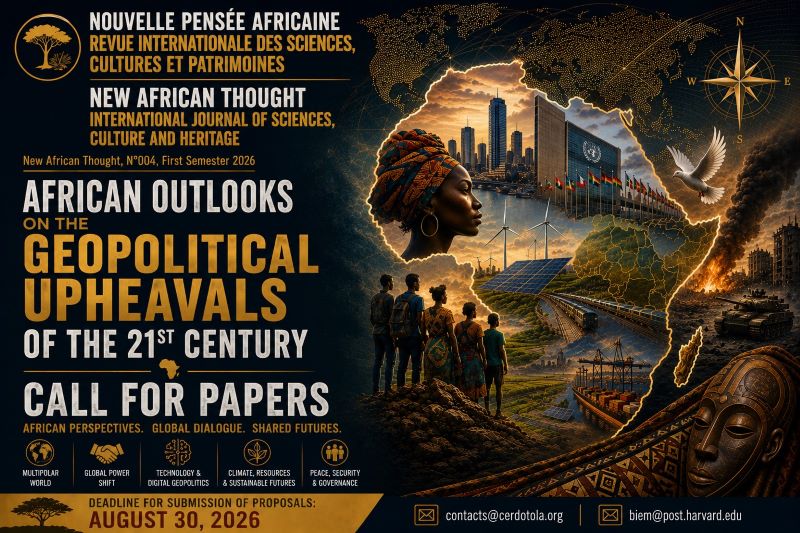
Appel à contributions
Soumettez vos travaux à la Revue Nouvelle Pensée Africaine
Appel permanent
APPEL A CONTRIBUTION PERMANENT
L’interpellation de la revue Nouvelle Pensée Africaine (NPA), pour un renouvellement de fond en comble de la pensée africaine, vient du parcours entier de la pensée africaine moderne et de ses (in)aboutissements provisoires qui imposent de reprendre en mains propres les projections d’avenir et leurs fondements. De fait, si elles font l’objet d’alignements programmatiques au niveau institutionnel, les nouvelles projections d’un avenir prospère de l’Afrique restent globalement non théorisées, peu conceptualisées, voire suspectes. En moins d’une décennie, sans transition et presque par décret, l’on est passé de la longue maladie de l’image du hopeless continent et du shackled continent à une anomalie de la pensée qui se décline sous les tropismes de l’Africa rising, de l’emerging Africa et d’autres, dont la prise en charge est pour le moins lacunaire dans la pensée africaine et africaniste. Du reste, cette pensée contemporaine apparaît elle-même bien peu sûre de son langage, au sens de la cohérence d’ensemble de ses logiques et de l’interrogation sur elle-même, ses propres opérations, ses objets, priorités et finalités, contrairement à ce que fut la pensée africaine des phases décisives antérieures.
Certes, la pensée africaine n’a pas toujours montré l’intensité réflexive atteinte avec le débat sur la « philosophie africaine » et les repositionnements épistémologiques afrocentristes, mais les penseurs africains et afrodescendants modernes se sont toujours préoccupés de penser ensemble la saisie critique de la condition négro-africaine et l’adéquation de la pensée aux finalités. A la suite des précurseurs (A. W. Amo, E. W. Blyden, M. Garvey, W. E. B. Du Bois, etc.), la montée en puissance des mouvements qui suit l’institutionnalisation de la Conférence panafricaine à partir de 1919 trace la voie sur deux sillons thématiques incontournables : l’identité et l’émancipation qui posent le problème axial de l’être-africain-au-monde et sa responsabilité envers lui-même et le monde.
Ce qui débride par la suite les créativités artistiques et littéraires des mouvements comme la négro-renaissance de Harlem des années 1920 et la négritude à partir des années 1930, c’est bien la prise en charge de la condition raciale africaine dont le traitement cognitif et revendicatif contribue à la montée de la pensée mondiale sur la condition humaine, et à l’institutionnalisation du discours des droits, y compris à l’autodétermination. L’émergence d’un internationalisme noir militant consacre alors la centralité des problèmes et finalités de souveraineté et d’unité au cœur du panafricanisme maximaliste dont se saisiront, mutatis mutandis, l’ensemble des penseurs et des pères fondateurs des Etats indépendants et de l’OUA. Il est indéniable que la conjonction de la pensée et de son activation via des mouvements d’idées soutenant et orientant les mouvements sociopolitiques d’émancipation pendant un demi-siècle, a largement contribué aux résultats historiques du 20ème siècle : l’Indépendance juridico-nominale et l’Unité de principe de l’Afrique.
A contrario, focalisée sur l’économie et les institutions, la « renaissance africaine » du tournant du siècle a perdu de vue que la Renaissance est d’abord et historiquement suscitée, soutenue et accélérée par la culture, la créativité, l’imaginaire, la pensée. Parce que non pensé, le concept pourtant valide de Renaissance africaine a été galvaudé et expulsé en moins de dix ans du lexique des bonnes fins politiques et stratégiques de l’UA. On lui a substitué l’émergence qui, procédant par insinuation hétéronome et ne reposant sur aucun travail de systématisation ni aucun corpus d’idées probantes, apparait comme un paradigme sans concepts. Dans les interactions complexes et conflictogènes de la transition hégémonique du 21ème siècle, la propension à projeter l’indépendance stratégique, l’Unité effective et la transformation productive de l’Afrique sans une nouvelle pensée africaine (NPA) conséquente et organisée, est clairement rédhibitoire.
Ces errements découlent aussi d’un long appauvrissement de la pensée africaine en termes de projet. Devenue pour l’essentiel et sur des décennies une pensée du regret sur les indépendances décevantes, elle a négligé la prise en charge des réserves de vitalité, de créativité et de productivité pour privilégier le sort funeste que le pouvoir, un certain pouvoir africain sur l’Africain, fait à la vie africaine. Il est grand temps d’en finir avec cette éclipse de la réflexion, de clore le déclin civilisationnel africain que prolonge l’éclipse, et d’opérer la plus décisive des relances, une véritable et puissante renaissance de la pensée africaine qu’exigent les enjeux vitaux de l’avenir.
A cet effet, la NPA propose de mettre en débat ce questionnement axial : un siècle après la Première Conférence panafricaine et face aux régressions et nouveaux enjeux, à quelles conditions, sur quelles bases, avec quels objets et modalités, dans quelles directions et pour quelles finalités peut-on pertinemment envisager aujourd’hui une nouvelle pensée africaine ? Quels mouvements de pensée, de créativité et d’action collective pourraient être engagés pour préciser conceptuellement, soutenir et accélérer les transformations africaines désirables, projetées ou déjà à l’œuvre ? Comment situer, activer et pérenniser une NPA en rapport aussi bien avec l’ensemble de ses héritages africains et mondiaux qu’en adéquation avec ses objets, priorités et finalités ? Au moment où la pensée mondiale, confrontée à une crise de la rationalité, dépend largement des structures et de la dialectique qu’elle sait pourtant dépasser pour mieux saisir les interactions complexes et faire surgir ou rendre compte des émergences, comment activer, avec les influences méthodologiques et épistémologiques utiles, les avantages africains dans le dépassement des modes de pensée oppressifs et de la pensée des systèmes de domination que ciblent aussi bien le paradigme émancipationniste africain que la théorie critique eurocentrée ? Comment en finir avec la dichotomie entre la reconnaissance de la nécessite pour l’Afrique de devenir son propre centre et les soupçons entretenus contre l’afrocentricité ? Comment valoriser la pensée actuelle pour neutraliser son atomisation individualiste et la réengager vers les dynamiques transformationnelles nécessaires d’une NPA ? Quelles dimensions novatrices dans les ensembles discursifs devraient définir et caractériser la NPA par rapport aussi bien à la pensée mondiale, ancienne et nouvelle, qu’en rapport aux stades advenus de la pensée africaine elle-même ? Quel serait le paradigme le plus adéquat au sein duquel la NPA pourrait mieux produire ses outils critiques, définir et contrôler ses démarches, se fixer constamment des buts pertinents, justifier à elle-même les procédures qu’elle mettra en œuvre pour les atteindre, se mettre en capacité de se juger pour établir rigoureusement ce qui en elle est pertinent par rapport à l’entreprise qu’elle constitue, et statuer, pour les sanctionner, sur la valeur et les limites de validité de ce qu’elle produit, afin de s’assurer qu’elle est toujours à la portée et à la hauteur de ce qu’elle affirme, projette ou effectue ?
Définissant un nouvel esprit avec des déclinaisons praxéologiques sectorielles (nouvelle pensée sociale, politique, économique, etc.), les contributions sont invitées sur cinq grands axes :
1. NPA de la prospérité… pour Reconcevoir et dépasser le « développement ». Depuis que l’Afrique adhère aux schémas et stratégies de développement, les piètres effets obligent à reposer sans concession le problème des résultats et leurs corollaires cognitifs et praxéologiques. Plutôt que de ressasser comment l’Afrique accepte ou non le développement, l’incertitude se réduit par un recours préjudiciel aux instances conceptuelles. Au regard aussi bien des crises des conceptions du développement que des échecs de leur mise en œuvre en Afrique, le Continent est astreint à l’impérieuse obligation de procéder, à partir d’elle-même, à la redéfinition du développement et de la construction de la prospérité avec des coordonnées et finalités plus adéquates, des images novatrices spécifiables des états finaux recherchés, ainsi que des processus et moyens, endogènes en particulier, pour y parvenir.
2. NPA du vivre ensemble… pour Réinventer le lien social, la politique et les institutions. Le cadre institutionnel arrêté en Afrique a pour composants matriciels une Union continentale à vocation fédérale ou confédérale ; des Etats-nations aux frontières coloniales intangibles, la démocratie libérale et l’économie de marché, le tout fondé sur une approche du lien social régie par l’idéologie individualiste et une conception du succès enfermée dans la compétition mimétique pour la consommation ostentatoire. Les penseurs, disciplines et champs des Sciences Sociales les plus pertinents mettent en évidence les erreurs dirimantes liées aux prescriptions individualistes du lien social pour des sociétés communautaires, et à l’échec prévisible des transplants de l’économie de marché et de la démocratie libérale sans adaptation translative à la culture et la mémoire historique locales. Il faut ici repenser de fond en comble les Etats et sociétés africains, à partir d’un projet enraciné qu’éclairent déjà les concepts de l’économie solidaire, de l’Etat multinational, de la démocratie consensualiste et d’autres alternatives endogènes à systématiser.
3. NPA des savoirs et de l’être… pour Refonder l’éducation et la recherche. La littérature spécialisée est quasi-unanime sur le fait que le modèle d’éducation en vigueur en Afrique aujourd’hui est encore largement d’inspiration coloniale, tandis que la recherche pâtit d’un fort désintérêt politique. Au-delà des analyses diagnostiques largement dominantes, la NPA explorera des modèles pouvant assurer l’atteinte des objectifs d’émancipation, de construction et de transformation en produisant, comme l’envisageait Kwame Nkrumah, des citoyens intègres, émancipateurs et bâtisseurs d’une Afrique nouvelle. La NPA doit régler les problématiques des institutions, contenus, acteurs, méthodes et ressources pour l’éducation, la recherche et l’innovation en lien avec les finalités de la transformation productive de l’Afrique et sa compétitivité dans les interactions complexes.
4. NPA des héritages et civilisations… pour Réengager l’activation des Arts, cultures et patrimoines comme leviers de la Renaissance. L’Afrique a vocation et intérêt à s’imposer comme un Etat-civilisation continental. Ce qui manque à la démarche institutionnalisée à cet effet relève largement de la culture, de l’arrangement des éléments constitutifs d’un ethos africain singulier et insubstituable hérités des grandes réalisations civilisationnelles de l’histoire et projetés vers l’avenir dans un vaste mouvement de Renaissance. Avec son thème pour l’année 2021, l’UA a amorcé un saut qualitatif en rejoignant la vision des plus grands penseurs progressistes jusque-là ignorée par les Institutions. Afin de systématiser cette convergence et ses formidables perspectives, les contributions dans cet axe devront explorer les voies et moyens pour l’Afrique de procéder comme l’Europe du 16ème siècle, notamment avec le projet diopien des Humanités classiques africaines, comme le Japon avec la Restauration Meiji pour construire la modernité sur le socle millénaire des traditions, ou encore comme la Chine, la Russie, la Turquie et d’autres dont l’émergence s’appuie sur la réactivation des traditions de grandeur en tant qu’Etats-civilisations dans les piliers des Arts, des Sciences, des Mystiques et des Philosophies qui portent le développement technologique.
5. NPA de la puissance symbiotique… pour Repenser stratégiquement le rapport de l’Afrique à la Puissance, au Temps et à l’Environnement. La prospective établit que l’échec des projections du type silencing the guns in 2020 de l’UA est exemplaire des résultats les plus probables des agendas nationaux, sous-régionaux et panafricains du courant de l’emerging Africa. Il en est de même pour l’adhésion de l’Afrique au diptyque réduction-adaptation à elle imposé par les Accords internationaux sur le climat et l’environnement. Cet axe explorera les éléments d’une NPA de la puissance qui active les ressources de l’histoire et de l’intelligence environnementale de l’Afrique pour servir de fondation, d’aiguillon et de composante des projections et soutenir l’atteinte des objectifs des stratégies officielles d’émergence. Est crucial à cet effet l’examen du travail nécessaire d’ajustement desdits objectifs en vue de leur dépassement dans les faits et l’horizon prospectif.
Les propositions de contribution (500-1000 mots) en français ou en anglais, indiquant trois à cinq mots-clés, ainsi que l’affiliation institutionnelle et la qualité des auteurs, devront être envoyées simultanément aux adresses suivantes : npa@cerdotola.org, redaction.npa@cerdotola.org, et contact@cerdotola.org . La Revue utilise le format APA.
Certes, la pensée africaine n’a pas toujours montré l’intensité réflexive atteinte avec le débat sur la « philosophie africaine » et les repositionnements épistémologiques afrocentristes, mais les penseurs africains et afrodescendants modernes se sont toujours préoccupés de penser ensemble la saisie critique de la condition négro-africaine et l’adéquation de la pensée aux finalités. A la suite des précurseurs (A. W. Amo, E. W. Blyden, M. Garvey, W. E. B. Du Bois, etc.), la montée en puissance des mouvements qui suit l’institutionnalisation de la Conférence panafricaine à partir de 1919 trace la voie sur deux sillons thématiques incontournables : l’identité et l’émancipation qui posent le problème axial de l’être-africain-au-monde et sa responsabilité envers lui-même et le monde.
Ce qui débride par la suite les créativités artistiques et littéraires des mouvements comme la négro-renaissance de Harlem des années 1920 et la négritude à partir des années 1930, c’est bien la prise en charge de la condition raciale africaine dont le traitement cognitif et revendicatif contribue à la montée de la pensée mondiale sur la condition humaine, et à l’institutionnalisation du discours des droits, y compris à l’autodétermination. L’émergence d’un internationalisme noir militant consacre alors la centralité des problèmes et finalités de souveraineté et d’unité au cœur du panafricanisme maximaliste dont se saisiront, mutatis mutandis, l’ensemble des penseurs et des pères fondateurs des Etats indépendants et de l’OUA. Il est indéniable que la conjonction de la pensée et de son activation via des mouvements d’idées soutenant et orientant les mouvements sociopolitiques d’émancipation pendant un demi-siècle, a largement contribué aux résultats historiques du 20ème siècle : l’Indépendance juridico-nominale et l’Unité de principe de l’Afrique.
A contrario, focalisée sur l’économie et les institutions, la « renaissance africaine » du tournant du siècle a perdu de vue que la Renaissance est d’abord et historiquement suscitée, soutenue et accélérée par la culture, la créativité, l’imaginaire, la pensée. Parce que non pensé, le concept pourtant valide de Renaissance africaine a été galvaudé et expulsé en moins de dix ans du lexique des bonnes fins politiques et stratégiques de l’UA. On lui a substitué l’émergence qui, procédant par insinuation hétéronome et ne reposant sur aucun travail de systématisation ni aucun corpus d’idées probantes, apparait comme un paradigme sans concepts. Dans les interactions complexes et conflictogènes de la transition hégémonique du 21ème siècle, la propension à projeter l’indépendance stratégique, l’Unité effective et la transformation productive de l’Afrique sans une nouvelle pensée africaine (NPA) conséquente et organisée, est clairement rédhibitoire.
Ces errements découlent aussi d’un long appauvrissement de la pensée africaine en termes de projet. Devenue pour l’essentiel et sur des décennies une pensée du regret sur les indépendances décevantes, elle a négligé la prise en charge des réserves de vitalité, de créativité et de productivité pour privilégier le sort funeste que le pouvoir, un certain pouvoir africain sur l’Africain, fait à la vie africaine. Il est grand temps d’en finir avec cette éclipse de la réflexion, de clore le déclin civilisationnel africain que prolonge l’éclipse, et d’opérer la plus décisive des relances, une véritable et puissante renaissance de la pensée africaine qu’exigent les enjeux vitaux de l’avenir.
A cet effet, la NPA propose de mettre en débat ce questionnement axial : un siècle après la Première Conférence panafricaine et face aux régressions et nouveaux enjeux, à quelles conditions, sur quelles bases, avec quels objets et modalités, dans quelles directions et pour quelles finalités peut-on pertinemment envisager aujourd’hui une nouvelle pensée africaine ? Quels mouvements de pensée, de créativité et d’action collective pourraient être engagés pour préciser conceptuellement, soutenir et accélérer les transformations africaines désirables, projetées ou déjà à l’œuvre ? Comment situer, activer et pérenniser une NPA en rapport aussi bien avec l’ensemble de ses héritages africains et mondiaux qu’en adéquation avec ses objets, priorités et finalités ? Au moment où la pensée mondiale, confrontée à une crise de la rationalité, dépend largement des structures et de la dialectique qu’elle sait pourtant dépasser pour mieux saisir les interactions complexes et faire surgir ou rendre compte des émergences, comment activer, avec les influences méthodologiques et épistémologiques utiles, les avantages africains dans le dépassement des modes de pensée oppressifs et de la pensée des systèmes de domination que ciblent aussi bien le paradigme émancipationniste africain que la théorie critique eurocentrée ? Comment en finir avec la dichotomie entre la reconnaissance de la nécessite pour l’Afrique de devenir son propre centre et les soupçons entretenus contre l’afrocentricité ? Comment valoriser la pensée actuelle pour neutraliser son atomisation individualiste et la réengager vers les dynamiques transformationnelles nécessaires d’une NPA ? Quelles dimensions novatrices dans les ensembles discursifs devraient définir et caractériser la NPA par rapport aussi bien à la pensée mondiale, ancienne et nouvelle, qu’en rapport aux stades advenus de la pensée africaine elle-même ? Quel serait le paradigme le plus adéquat au sein duquel la NPA pourrait mieux produire ses outils critiques, définir et contrôler ses démarches, se fixer constamment des buts pertinents, justifier à elle-même les procédures qu’elle mettra en œuvre pour les atteindre, se mettre en capacité de se juger pour établir rigoureusement ce qui en elle est pertinent par rapport à l’entreprise qu’elle constitue, et statuer, pour les sanctionner, sur la valeur et les limites de validité de ce qu’elle produit, afin de s’assurer qu’elle est toujours à la portée et à la hauteur de ce qu’elle affirme, projette ou effectue ?
Définissant un nouvel esprit avec des déclinaisons praxéologiques sectorielles (nouvelle pensée sociale, politique, économique, etc.), les contributions sont invitées sur cinq grands axes :
1. NPA de la prospérité… pour Reconcevoir et dépasser le « développement ». Depuis que l’Afrique adhère aux schémas et stratégies de développement, les piètres effets obligent à reposer sans concession le problème des résultats et leurs corollaires cognitifs et praxéologiques. Plutôt que de ressasser comment l’Afrique accepte ou non le développement, l’incertitude se réduit par un recours préjudiciel aux instances conceptuelles. Au regard aussi bien des crises des conceptions du développement que des échecs de leur mise en œuvre en Afrique, le Continent est astreint à l’impérieuse obligation de procéder, à partir d’elle-même, à la redéfinition du développement et de la construction de la prospérité avec des coordonnées et finalités plus adéquates, des images novatrices spécifiables des états finaux recherchés, ainsi que des processus et moyens, endogènes en particulier, pour y parvenir.
2. NPA du vivre ensemble… pour Réinventer le lien social, la politique et les institutions. Le cadre institutionnel arrêté en Afrique a pour composants matriciels une Union continentale à vocation fédérale ou confédérale ; des Etats-nations aux frontières coloniales intangibles, la démocratie libérale et l’économie de marché, le tout fondé sur une approche du lien social régie par l’idéologie individualiste et une conception du succès enfermée dans la compétition mimétique pour la consommation ostentatoire. Les penseurs, disciplines et champs des Sciences Sociales les plus pertinents mettent en évidence les erreurs dirimantes liées aux prescriptions individualistes du lien social pour des sociétés communautaires, et à l’échec prévisible des transplants de l’économie de marché et de la démocratie libérale sans adaptation translative à la culture et la mémoire historique locales. Il faut ici repenser de fond en comble les Etats et sociétés africains, à partir d’un projet enraciné qu’éclairent déjà les concepts de l’économie solidaire, de l’Etat multinational, de la démocratie consensualiste et d’autres alternatives endogènes à systématiser.
3. NPA des savoirs et de l’être… pour Refonder l’éducation et la recherche. La littérature spécialisée est quasi-unanime sur le fait que le modèle d’éducation en vigueur en Afrique aujourd’hui est encore largement d’inspiration coloniale, tandis que la recherche pâtit d’un fort désintérêt politique. Au-delà des analyses diagnostiques largement dominantes, la NPA explorera des modèles pouvant assurer l’atteinte des objectifs d’émancipation, de construction et de transformation en produisant, comme l’envisageait Kwame Nkrumah, des citoyens intègres, émancipateurs et bâtisseurs d’une Afrique nouvelle. La NPA doit régler les problématiques des institutions, contenus, acteurs, méthodes et ressources pour l’éducation, la recherche et l’innovation en lien avec les finalités de la transformation productive de l’Afrique et sa compétitivité dans les interactions complexes.
4. NPA des héritages et civilisations… pour Réengager l’activation des Arts, cultures et patrimoines comme leviers de la Renaissance. L’Afrique a vocation et intérêt à s’imposer comme un Etat-civilisation continental. Ce qui manque à la démarche institutionnalisée à cet effet relève largement de la culture, de l’arrangement des éléments constitutifs d’un ethos africain singulier et insubstituable hérités des grandes réalisations civilisationnelles de l’histoire et projetés vers l’avenir dans un vaste mouvement de Renaissance. Avec son thème pour l’année 2021, l’UA a amorcé un saut qualitatif en rejoignant la vision des plus grands penseurs progressistes jusque-là ignorée par les Institutions. Afin de systématiser cette convergence et ses formidables perspectives, les contributions dans cet axe devront explorer les voies et moyens pour l’Afrique de procéder comme l’Europe du 16ème siècle, notamment avec le projet diopien des Humanités classiques africaines, comme le Japon avec la Restauration Meiji pour construire la modernité sur le socle millénaire des traditions, ou encore comme la Chine, la Russie, la Turquie et d’autres dont l’émergence s’appuie sur la réactivation des traditions de grandeur en tant qu’Etats-civilisations dans les piliers des Arts, des Sciences, des Mystiques et des Philosophies qui portent le développement technologique.
5. NPA de la puissance symbiotique… pour Repenser stratégiquement le rapport de l’Afrique à la Puissance, au Temps et à l’Environnement. La prospective établit que l’échec des projections du type silencing the guns in 2020 de l’UA est exemplaire des résultats les plus probables des agendas nationaux, sous-régionaux et panafricains du courant de l’emerging Africa. Il en est de même pour l’adhésion de l’Afrique au diptyque réduction-adaptation à elle imposé par les Accords internationaux sur le climat et l’environnement. Cet axe explorera les éléments d’une NPA de la puissance qui active les ressources de l’histoire et de l’intelligence environnementale de l’Afrique pour servir de fondation, d’aiguillon et de composante des projections et soutenir l’atteinte des objectifs des stratégies officielles d’émergence. Est crucial à cet effet l’examen du travail nécessaire d’ajustement desdits objectifs en vue de leur dépassement dans les faits et l’horizon prospectif.
Les propositions de contribution (500-1000 mots) en français ou en anglais, indiquant trois à cinq mots-clés, ainsi que l’affiliation institutionnelle et la qualité des auteurs, devront être envoyées simultanément aux adresses suivantes : npa@cerdotola.org, redaction.npa@cerdotola.org, et contact@cerdotola.org . La Revue utilise le format APA.
Pour soumettre une proposition, envoyez votre article à :
npa@cerdotola.org